"Little to Expect from U.S.-China Summit...Just an Extension of Uneasy Calm" - Brookings Institution

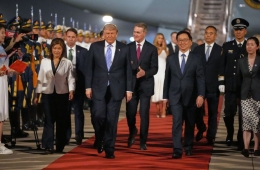
With U.S. President Donald Trump scheduled to visit Beijing for a summit with Chinese President Xi Jinping on May 14-15, experts at the Brookings Institution expect little from the U.S.-China summit amid heightened tensions, predicting it will merely extend the current uneasy calm.
The following is a summary of statements made by each expert, compiled as of May 5 (local time).
Jonathan A. Czin, Research Fellow at the John L. Thornton China Center, Brookings Institution: "Low Expectations Amid Heightened Tensions"
External observers should maintain low expectations for the upcoming Trump-Xi summit. Since the two leaders met in November last year, the bilateral relationship has stabilized but remains fragile. Rather than being defined by active agendas or deep dialogue on critical differences that trouble both countries, the relationship is more often characterized by the absence of friction. Many Chinese analysts expect the United States to revert to a more competitive China policy after the midterm elections or after Trump leaves office in 2029. Beijing appears to be focusing on strengthening its position against the U.S. during this transitional period. Similarly, many in the Trump administration and Congress prefer a return to ongoing strategic competition.
The diplomatic process for this summit has only amplified the deeper factors that limit the chances for substantive results. Reports of inadequate bureaucratic preparation for the summit constrain the possibility of progress. Paradoxically, by publicly signaling early on this year that the Trump administration wanted multiple leader-level meetings, Beijing may have had less incentive to make significant concessions. Chinese officials believe that the longer they delay making concessions, the more they can extract in return. They calculate that Trump, who sees himself as the ultimate negotiator, will want to showcase any agreement as a major breakthrough ahead of the midterms.
Ryan Hass, Director of the John L. Thornton China Center: "Extension of the Uneasy Calm in U.S.-China Relations"
The key lesson Trump and Xi learned in 2025 is that while they can inflict harm on one another, they can only do so by enduring painful retaliation. As a result, the two leaders agreed to a trade war truce when they met on the sidelines of the Asia-Pacific Economic Cooperation (APEC) summit in Busan in October last year.
Trump appears to be focused on maintaining this truce and using the time to build defenses aimed at reducing U.S. dependence on China for critical inputs such as rare earths. This focus is likely to shape his visit to Beijing. In this sense, the summit is less about achieving positive outcomes and more about avoiding negative ones—most notably, attempting to prevent a breakdown in bilateral relations.
To be clear, there will be outcomes from Trump’s visit. The two leaders are highly likely to announce Chinese purchases of U.S. products such as Boeing aircraft and agricultural goods. There is also a possibility that they will launch a bilateral “trade commission” to monitor purchase commitments and make limited tariff adjustments in non-sensitive areas.
Key points to watch include whether China will announce large-scale investments in the U.S. and if there will be any potential change in the longstanding U.S. policy declarations regarding Taiwan.
Susan A. Thornton, Former U.S. Department of State Diplomat for East Asian Affairs: "The Need to End Estrangement"
For Americans, the most important outcome of Trump’s upcoming visit to Beijing may simply be that the visit is taking place at all. Since the COVID-19 pandemic, mutual distrust between the U.S. and Chinese governments has soared. Communication across the Pacific has been dramatically reduced. Joe Biden became the first U.S. president since the establishment of U.S.-China relations not to visit China. Congressional visits have also declined significantly. This estrangement has coincided with heightened bilateral tensions and the sudden, dramatic transformation of global power structures, norms, and institutions. At present, leader-level communication is the only safety valve in U.S.-China relations. We need this channel to prevent miscalculations from escalating into conflict.
Of course, it is not ideal that this summit is taking place against the backdrop of war with Iran. However, U.S. policy has repeatedly allowed urgent issues to crowd out important ones. Trump seems determined to prevent that from happening this time. He deserves credit for increasing communication with Xi Jinping in the first year of his second term. The Chinese leadership has similarly shown flexibility and willingness to keep this channel open. The two leaders have indicated they could potentially meet up to four times this year. Such meetings offer the best hope for avoiding miscalculation and are therefore welcome. Continued estrangement is simply too dangerous.
Kyle Chan, Research Fellow for Technology and Industry at the John L. Thornton China Center: "It Is Time for the U.S. and China to Talk About AI"
The United States and China are the world’s two leading artificial intelligence (AI) superpowers. In fact, nearly all of the most advanced and widely used AI models are developed in these two countries. As AI systems rapidly grow in capability, so do the risks they generate. Anthropic’s latest model, “Mythos,” has raised new concerns about AI-enabled cyberattack capabilities. Researchers warn that AI tools could help less sophisticated actors develop new biological weapons. The proliferation of AI agents capable of autonomous operation for hours at a time raises concerns about unintended actions and loss of control over these systems.
Yet, at least at the official level, the U.S. and China have had virtually no dialogue on AI. Both countries view AI as a critical strategic technology, and the relationship in this field is marked by low trust and intense competition. However, with suggestions that Trump and Xi could discuss AI at the upcoming Beijing summit, this could change. While the U.S. and China will almost certainly continue fierce competition in AI, ideally, the two leaders could also take steps to cooperate in areas where they have shared interests.
Trump and Xi could begin by opening an official channel for communication on AI risks, developing non-binding safety guidelines, and sharing limited information on AI misuse or safety incidents. Both countries will be cautious about any agreement that might constrain their own capabilities. Nevertheless, reestablishing official U.S.-China dialogue on AI would be a critical first step to address an increasingly urgent issue.
Vanda Felbab-Brown, Senior Fellow in Foreign Policy at the Brookings Institution: "Trump Has Lost the Fentanyl Leverage"
Fentanyl and precursor chemicals for synthetic opioids remain a crucial issue in U.S.-China relations, but the Trump administration has weakened its leverage. By October 2025, China had outmaneuvered the U.S. in fentanyl diplomacy. China absorbed Trump’s early 2025 tariffs while retaliating with counter-tariffs, export controls on critical minerals, and boycotts of sensitive U.S. imports such as soybeans. In subsequent diplomatic rounds, China gave the Trump administration the same deliverables it had provided the Biden administration at the end of 2024—specifically, designating nitazenes and several fentanyl precursors as controlled substances.
The U.S.-China working group on narcotics remains operational, but U.S. officials say cooperation is not as robust as it was at the end of 2024. At the United Nations drug meetings in March 2026, U.S.-China exchanges were tense. The U.S. delegation complained that China was not doing enough to block fentanyl precursors, while China accused Washington of “unilateral bullying.”
In reality, the Trump administration has allowed the “Global Coalition to Address Synthetic Drug Threats,” launched under Biden, to stagnate, thereby abandoning a multilateral pressure tool that had elicited responses from China. The “China Fentanyl Block Act,” a new U.S. bill that would impose visa bans and other sanctions on Chinese officials and other actors if China fails to cooperate in stopping synthetic drug flows, is still pending in the Senate.
In March 2026, the U.S. began prosecuting Chinese precursor traffickers for providing material support for terrorism, following its designation of Mexican cartels as foreign terrorist organizations. While this is an unpleasant stimulus for China, it remains relatively minor. A much greater provocation would be if the U.S. government continues to list China as a major illicit drug source country in its key September report.
Scott M. Moore, Professor of Political Science at the University of Pennsylvania: "Oil, Coal, and Power Politics"
The climate and energy dimensions of the Iran conflict will cast a shadow over the Trump-Xi summit in two ways. On one hand, disruptions in the energy market have significantly raised China’s energy import costs and almost certainly led to increased coal use. Xi Jinping will be particularly focused on minimizing this disruption, especially if the conflict is still ongoing when the summit begins. On the other hand, the conflict has validated China’s approach to energy security. China has pursued an “all means necessary” strategy to develop both fossil and non-fossil energy and electrify its energy system. This strategy allows for optimal integration of diverse power sources and expanding storage capacity. Long-term investments to expand oil and gas supplies via overland routes, particularly from Russia, rather than by sea, also appear sound. As a result, China is now less exposed to supply disruptions and price volatility than in the past. The success of this approach should ultimately be measured by the extent to which China is willing to purchase U.S. energy as opposed to continuing to buy from Iran, Russia, and other U.S. adversaries.
Michael O’Hanlon, Director of the Center for Security, Strategy, and Technology at the Brookings Institution: "Principled Toughness, Strategic Restraint"
The Trump administration’s China strategy, as detailed in the National Security Strategy, National Defense Strategy, and the annual Congressional report on the People’s Liberation Army, is sound. Trump should maintain an overall positive tone, but be specific and resolute in objecting to key aspects of Beijing’s policy that require pushback. These include issues such as religious rights, minority rights, dissident rights, Hong Kong policy, military support to Russia as well as support to Iran and North Korea, the Chinese military’s approach to Taiwan, intellectual property theft, unfair subsidies to certain domestic industries, malware like Volt Typhoon planted in U.S. infrastructure cyber systems, and especially the rapid modernization of the People’s Liberation Army in areas such as nuclear weapons. Expecting China not to convert its growing wealth and power into stronger military capabilities is naive, but certain aspects of that modernization and the military’s actions should be criticized.
Trump should also avoid some of the hardline rhetoric recently used by U.S. officials toward China. He should not accuse China of genocide, label it as part of a new “axis of evil,” or refer to it as an enemy or even an adversary. Such language is too harsh, inflammatory, or sweeping to be productive or fair. Criticism is acceptable—and even necessary—but exaggeration and personal attacks are unwise.
Hot Picks Today
 Even with High Oil Price Relief Payment, Additional 300,000 Won Per Person to Be Provided... Applications Open from the 18th in This Region
- "Invested 95% in Hynix and Reached 10 Billion Won"... Japanese Investor's Proof Post Goes Viral
- "Why Is the Korean Stock Market Surging?"... Even Italy Is Astonished by the KOSPI Rally
- "You Don't Need to Go to the Gym": The Best Exercises for Lowering Hypertension
- "That Thing Wakes Up Every Night" ... Suspicious Object Covers Rural Village
This approach—firmly objecting on specific issues while maintaining mutual respect, and even a measure of goodwill, in personal and overall bilateral relations—maximizes the potential for constructive engagement and minimizes the risk of war. This final goal is, above all, the most important criterion by which I evaluate the outcome of this summit and indeed most modern U.S.-China summits.
© The Asia Business Daily(www.asiae.co.kr). All rights reserved.